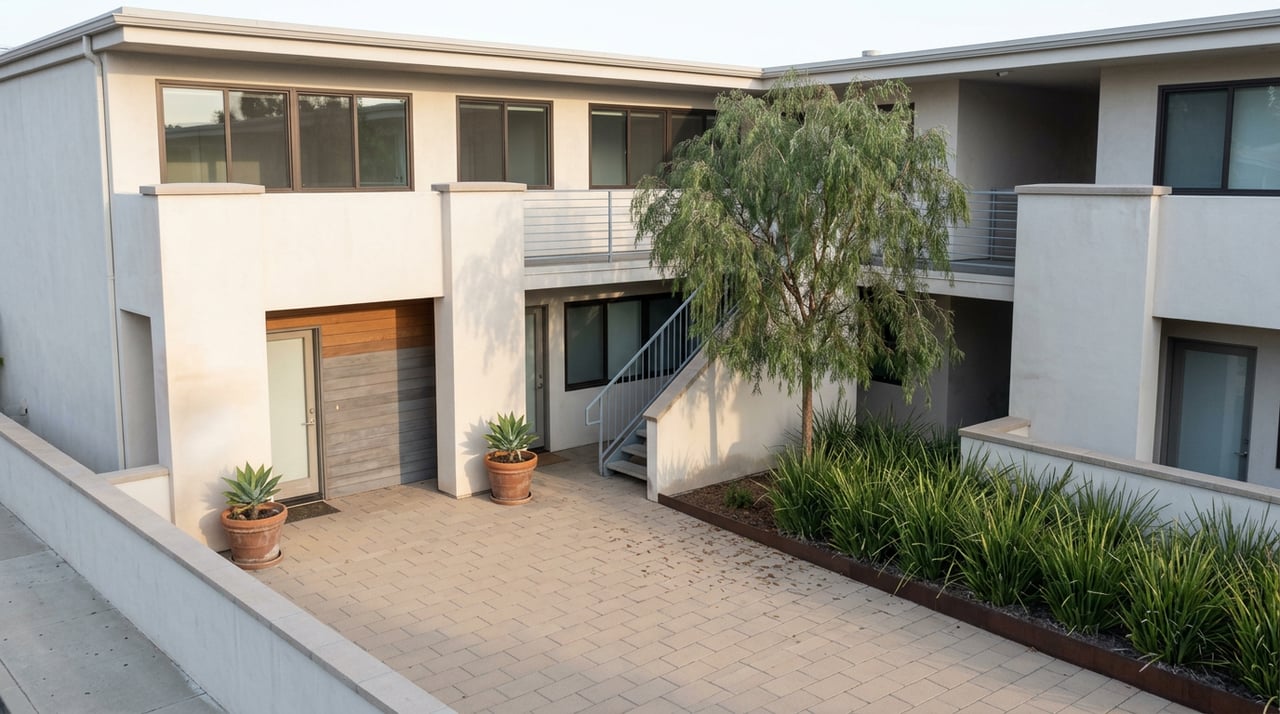
Picture a three-story stucco apartment building two blocks off Ventura Boulevard, the kind with a name in curved script over the entrance and eight or ten units stacked above a row of open carports. Studio City has dozens of these. They went up fast and cheap in the 1950s and 60s, and for seventy years nobody outside a structural engineering office thought much about what holds up that open ground floor.
Now it matters, because the deadline to fix it already came and went.
Los Angeles set April 2026 as the compliance deadline for Priority 2 soft-story buildings under its mandatory seismic retrofit ordinance, and that window covers exactly the kind of small apartment building that fills the residential streets around Studio City's commercial corridor. As of this writing, that date is five months behind us. Most sellers, and a fair number of agents, are still talking about the retrofit deadline as something coming up. It isn't. The conversation that matters now is what happens in escrow when a building missed it.
What the Ordinance Actually Covers, and Why Studio City Has So Many Candidates
Los Angeles adopted its mandatory retrofit program under Ordinance 183893, later amended by Ordinance 184081, after building officials identified roughly 13,500 wood-frame buildings across the city with the structural signature that makes soft-story buildings dangerous: two or more stories of wood-frame construction, built before 1978, with parking or other open space on the ground floor and no residential exemption below four units. The Los Angeles Department of Building and Safety split enforcement into two priority tiers.
Priority 1 covered the highest-risk buildings, three or more stories with ground-floor commercial space, and that group's deadline to complete construction was April 2024. Priority 2 is everything else in scope, which in practice means the two- and three-story residential buildings with tuck-under parking that architectural writers call dingbats. That deadline was April 2026.
| Priority Tier | Building Profile | Compliance Deadline |
|---|---|---|
| Priority 1 | 3+ stories, ground-floor commercial | April 2024 (completed construction) |
| Priority 2 | 2-3 story residential, tuck-under parking | April 2026 (completed construction) |
Studio City's residential blocks are disproportionately Priority 2 territory. The dingbat, as a building type, exploded in popularity across the San Fernando Valley in the mid-1950s through the 1960s precisely because it let a developer fit a dense, income-producing property on a single-family-sized lot with built-in parking underneath. Bloomberg's CityLab has traced the type's roots directly to the Valley as one of its original growth areas. Seventy years later, that construction choice is the reason a meaningful share of Studio City's small apartment stock is sitting past its compliance date.
The Gap Nobody's Pricing Yet
Here is the part that actually changes how a transaction should be handled right now. A missed deadline does not trigger an automatic, same-day consequence. LADBS enforcement runs on its own bureaucratic clock: notices, escalating fines, and eventually liens recorded against the property, but that sequence takes time to work through the system. A building can be five months past its Priority 2 deadline and still show a clean title report today.
That gap between "non-compliant" and "flagged as non-compliant" is exactly where a lot of current Studio City deals are quietly happening. A seller who never retrofitted may not have received an enforcement notice yet. A buyer who doesn't ask the right question at the right point in escrow may not find out until a lender or insurer asks it for them, usually later in the process, usually at a worse moment to renegotiate.
The retrofit status of a Studio City apartment building has stopped being a due diligence footnote. It's become one of the first things that determines whether a deal can close on the terms both sides thought they'd agreed to.
The Discount Math That's Actually in Play
Non-compliant soft-story buildings in Los Angeles have been trading at a real discount to comparable retrofitted stock, reflecting the cost a buyer has to absorb to bring the building current. Retrofit costs vary by size, but structural engineers and compliance contractors working these projects commonly cite per-unit costs somewhere in the $10,000 to $30,000 range, with total project costs for a typical Valley-sized apartment building running anywhere from around $20,000 for a small property into six figures for a larger one, depending on the number of units and the complexity of the frame work required.
That is not a small number to negotiate around after an offer is already accepted. It is a number that belongs in the initial pricing conversation, on both sides.
For a seller, that means getting an engineer's retrofit estimate before setting a list price, not after a buyer's inspector raises it. Pricing a non-compliant building as if it were retrofitted invites a renegotiation later in escrow, usually on worse terms than if the discount had been built in from the start.
For a buyer, it means the discount is often real money, not just leverage. A building priced to reflect a genuine retrofit cost can be a legitimate value-add opportunity, provided the buyer has actually priced the retrofit rather than assumed a number.
Why This Interacts With Rent Stabilization Too
There's a second layer that makes Studio City's older multifamily stock more complicated than a straightforward retrofit-or-discount conversation. Los Angeles's Rent Stabilization Ordinance generally applies to buildings built before 1978, the same age band that defines soft-story exposure under the retrofit ordinance. A lot of the buildings caught by one rule are caught by the other.
That overlap shows up in how the Studio City multifamily market has actually behaved. Deal activity in the neighborhood's 5-plus-unit segment increased meaningfully through 2025 after a thin 2024, but pricing told a split story. Buildings under rent stabilization traded on in-place cash flow and long-term yield, with cap rates that widened and per-square-foot pricing that softened, while newer, non-rent-controlled buildings commanded steadier per-unit pricing and shorter time on market. Add a retrofit obligation on top of that and the rent-controlled segment of Studio City's apartment stock is carrying two separate sources of buyer caution at once, not one.
There is a partial offset worth knowing about if you own one of these buildings. Landlords of rent-stabilized properties in Los Angeles can pass through up to 50 percent of seismic retrofit costs to tenants through a monthly surcharge, capped at $38 per unit for up to ten years, subject to approval from the Los Angeles Housing Department. It doesn't erase the upfront cost, but it changes the net math over a hold period, and it's worth running before deciding whether to retrofit and hold versus sell as-is.
What to Actually Do Before You Write or Accept an Offer
- Request the building's LADBS soft-story status before you write an offer. Don't wait for a lender to ask. A Certificate of Compliance, or the lack of one, should shape your opening number, not surface mid-escrow.
- Get a structural engineer's retrofit bid, not a rule-of-thumb estimate. Building size, parking configuration, and foundation condition all move the number meaningfully.
- Call the lender directly about their posture on non-compliant soft-story collateral. Some will fund with conditions, some won't fund at all until construction is underway. Find out before you're deep into a 30-day escrow.
- If the building is rent-stabilized, run the tenant pass-through math. The $38-per-month surcharge over ten years can meaningfully change whether retrofit-then-hold or sell-as-is is the stronger play.
- If you're selling non-compliant, decide early whether to retrofit first or price at the discount. A typical retrofit takes months from engineering through final inspection, which is a real timeline decision for a listing, not an afterthought.
The seismic reasoning behind all of this isn't abstract. The 1994 Northridge earthquake is the direct reason Los Angeles built this ordinance, and the collapse of the ground-floor parking level at the Northridge Meadows complex, which killed sixteen people, is the case that shaped the entire program. That history is part of why enforcement, however slow, isn't going away.
FAQ
Does this apply to my duplex or fourplex? The ordinance generally excludes residential buildings with three or fewer units. If your property has four or more units, wood-frame construction, and pre-1978 origins with ground-floor parking or open space, it's worth confirming your status with LADBS directly.
What if my building received an Order to Comply years ago and nothing happened since? The compliance clock runs from the date the order was received, not from the citywide deadline, with milestones at two years, three and a half years, and seven years. If you received an order early on, some of those internal deadlines may already be behind you regardless of the April 2026 date.
Can I still buy a non-compliant building? Yes, and for the right buyer it can be a genuine opportunity. The key is pricing the retrofit cost into your offer up front and confirming your lender will actually finance the property in its current condition.
If you're weighing a Studio City multifamily purchase or trying to figure out what a non-compliant building is actually worth on today's market, Mario Acosta works with investors across the San Fernando Valley on exactly this kind of pricing and negotiation question. Get a free home valuation to start the conversation with real numbers instead of assumptions.